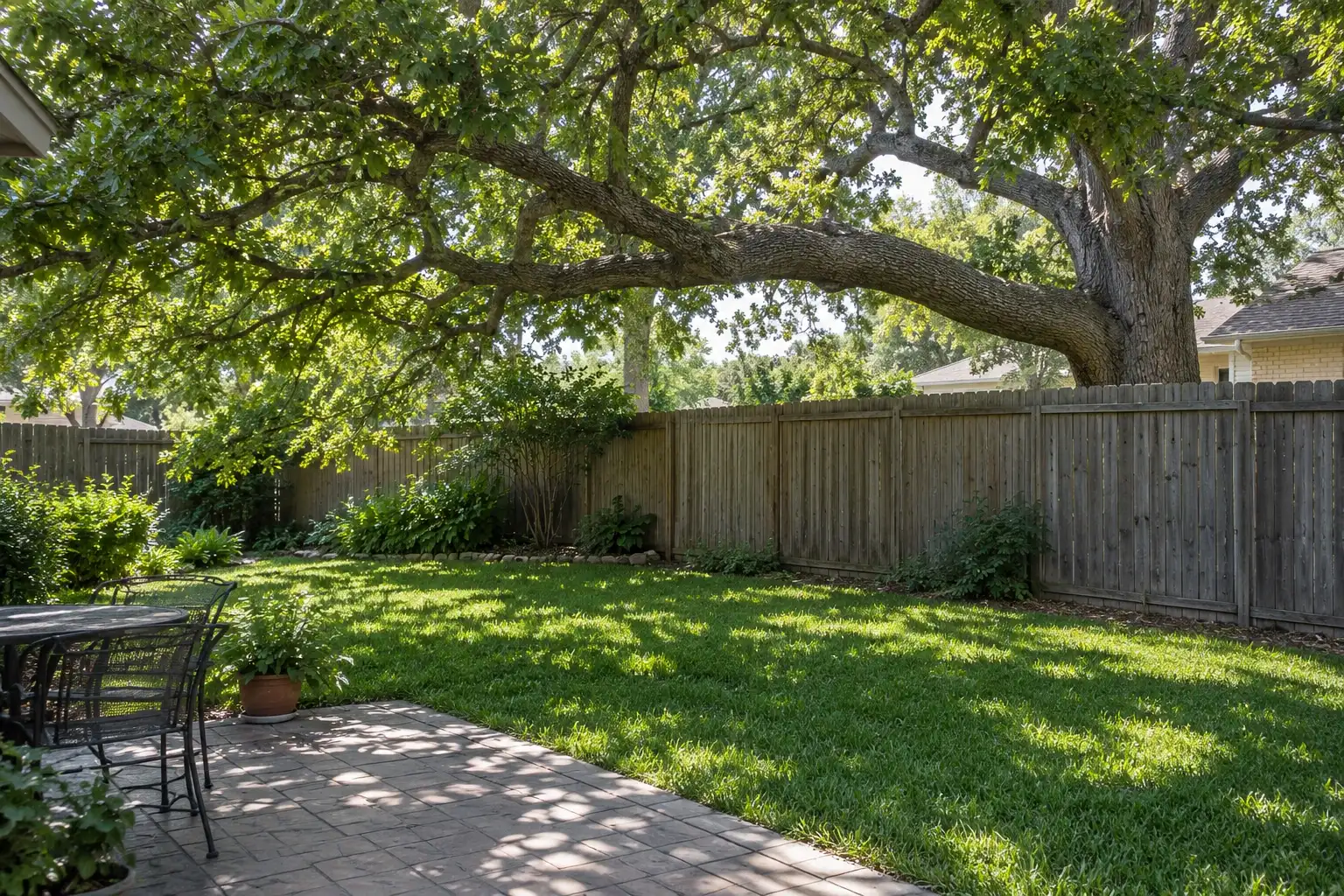
Neighbor tree disputes are among the most common tree questions in the Midlands, especially in older neighborhoods like Shandon, Dentsville and Seven Oaks, where big oaks grew up across lot lines decades ago. This guide explains the general principles. It is not legal advice. For a dispute that matters, talk to a South Carolina attorney or your insurer.
Who owns the tree?
The general rule: a tree belongs to the owner of the land where its trunk stands. It does not matter where the branches reach or where the roots run. If the trunk is entirely on your neighbor’s side, it is their tree, even if most of the canopy is over your yard.
A tree whose trunk straddles the property line is generally treated as shared by both owners. Neither owner should remove it or seriously damage it without the other’s agreement. If you are not sure where the line runs, a survey or your plat settles it; the parcel maps that Richland County and Lexington County publish online are a good first look, but they are not a survey.
Branches hanging over your yard
In general, you may trim branches that overhang your property, up to the property line, at your own expense, as long as:
- you stay on your side of the line (no going onto your neighbor’s property);
- you do not kill or seriously damage the tree, for example by cutting so much of one side that it becomes unstable, or by cutting major roots close to the trunk;
- you do not top the tree or leave it lopsided and hazardous.
Good pruning practice matters here. Cuts should be made at a branch union or just outside the branch collar, not as flush cuts or stubs (Clemson HGIC). Removing more than a modest amount of a big tree’s crown from one side can harm it, and harming a neighbor’s tree can make you liable.
Talk to your neighbor first. Most disputes are avoided by a friendly conversation and an offer to share the cost of proper pruning.
Roots
Roots from a neighbor’s tree that lift your driveway or invade a sewer line raise the same principle: you can generally deal with roots on your side, but cutting large roots close to the trunk can kill or destabilize the tree, and a destabilized tree that then falls can create liability. Get an arborist’s view before cutting big roots.
When a tree falls: who pays?
This is where most of the confusion is.
A healthy tree falls in a storm
When a healthy tree falls because of wind, lightning or ice, insurers generally treat it as an act of nature (think of a sound pine blown over by Hurricane Helene’s winds in September 2024). Each owner’s own insurance usually covers damage to their own property, including when the neighbor’s tree lands on your house. Your insurer may cover removal of the tree from your structure, often with a per-tree limit.
A dead or hazardous tree falls
If the tree was dead, dying, decayed or obviously hazardous, and the owner knew or reasonably should have known, the owner may be found negligent and responsible for the damage. Warning signs like a bare crown, large cracks, fungal conks or a lean that kept getting worse are the kind of evidence that matters. See dead and hazardous trees.
A tree falls and hits nothing
Cleanup of a tree that falls on open ground is usually the owner’s cost, and many policies do not cover it.
If you are worried about a neighbor’s tree
- Look, but stay on your side. Photograph the tree from your property: cracks, dead limbs, lean, mushrooms at the base.
- Tell your neighbor in writing. A friendly note or email with photos, suggesting an arborist assessment.
- Keep a copy. If the tree later fails, a record that the owner was told is important.
- Offer to share costs if the tree affects both properties.
- If it is urgent (cracking, leaning onto your house), call your insurer and, if lines are involved, the utility.
A short note you can adapt
Hi [name], I noticed the big oak near our shared fence has a crack running down the trunk and a few large dead limbs over our roof (photos attached). I’m worried about it with storm season coming. Would you be open to having an arborist take a look? Happy to split the cost of the visit.
If your neighbor is worried about your tree
Take it seriously. Get the tree looked at, keep the report, and act on what it says. A modest bill for pruning or removal now is far cheaper than a negligence claim later. See tree removal in Columbia and the cost guide.