Most homeowners in the Columbia area can remove a tree from their own yard without a city permit. But “most” hides a lot: Forest Acres, development sites, street trees, Lake Murray shoreline and HOAs all have their own rules, and the same metro area can mean three different governments depending on your address. This guide goes place by place. It reflects what we checked in November 2026; rules change, so confirm with the office named before you cut.
Quick decision table
| Where the tree is | Permit needed? | Who decides |
|---|---|---|
| Single-family lot, City of Columbia | Usually no | City of Columbia Planning & Development |
| Commercial, multifamily or development site, City of Columbia | Often yes | City of Columbia Planning & Development |
| Street tree in the right-of-way | Not yours to remove | City (Forestry & Beautification) or SCDOT |
| Any governed tree in Forest Acres | Yes, plus a city-licensed contractor | City of Forest Acres |
| Town of Lexington | Mainly for development; check | Town of Lexington Planning |
| West Columbia, Cayce, Irmo, Blythewood, Elgin, Chapin | Check with the town | Each town’s planning office |
| Unincorporated Richland or Lexington County | Usually no for homeowners | The county |
| Lake Murray shoreline below the 360-ft contour | Dominion Energy approval | Dominion Energy Lake Management |
| Any HOA community | Often HOA approval | Your HOA |
City of Columbia
The City of Columbia’s tree removal permit applies to private property but excludes single-family residential lots (City of Columbia Planning & Development). If you own a house on a single-family lot inside city limits, removing a tree in your own yard generally does not need a city permit.
Two situations are different:
- Commercial, multifamily and development sites. Projects on these properties can trigger a tree survey and a tree protection plan, and removal of protected trees may need approval and replacement.
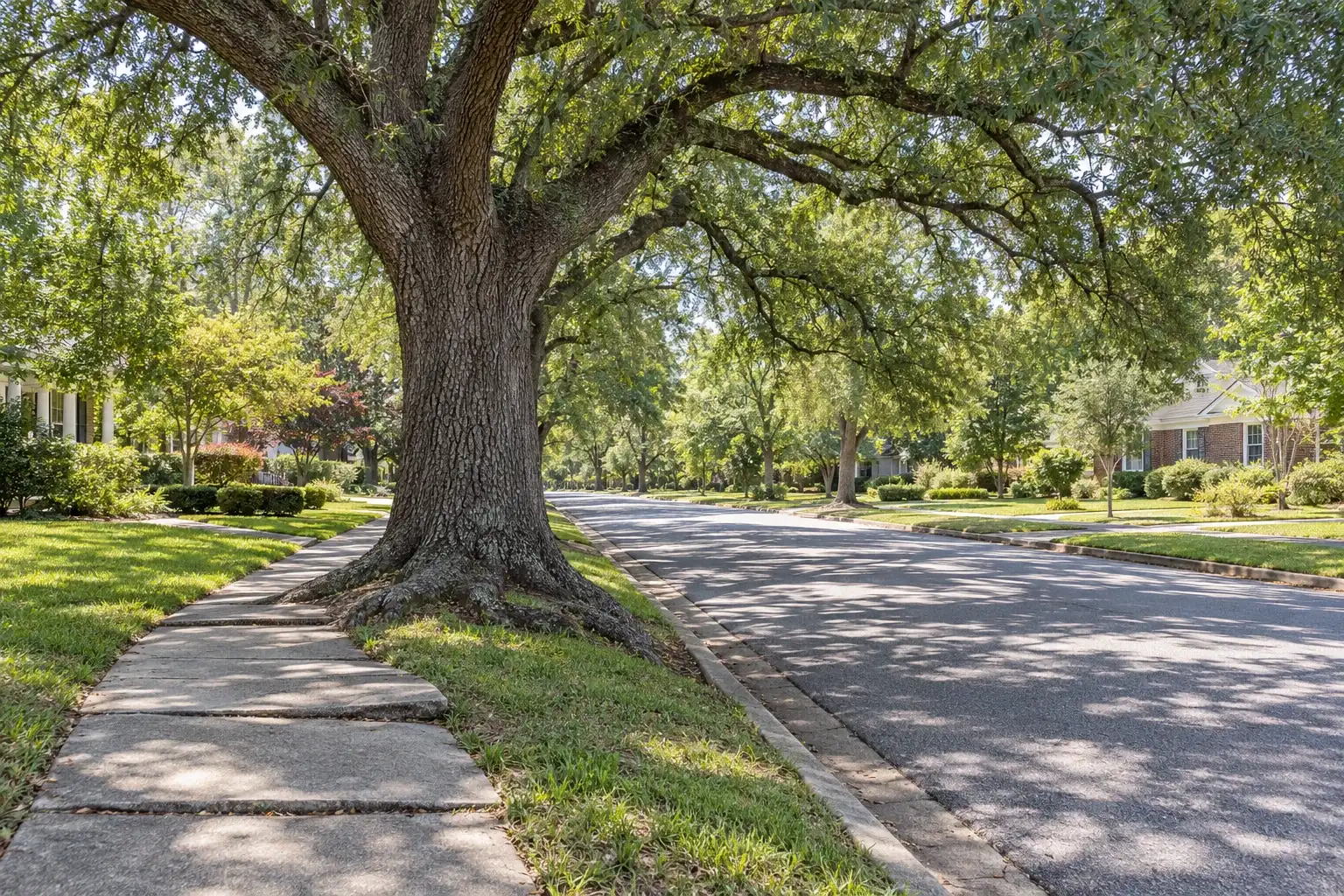
- Street trees. Trees in the public right-of-way, usually the strip between the sidewalk and the street, belong to the city, not the homeowner. The City of Columbia’s Forestry and Beautification division handles them. On state roads, SCDOT is responsible.
Not sure whether your address is in the city? Many “Columbia” mailing addresses are actually in unincorporated Richland or Lexington County. Your property tax bill shows the jurisdiction.
Forest Acres: the big exception
Forest Acres takes trees more seriously than anywhere else in the Midlands. According to the city:
- a tree removal permit is required for trees governed by the city’s tree ordinance, even when the property owner cuts the tree;
- approved removals must be done by a contractor licensed with the City of Forest Acres; a state license alone does not meet the requirement (City of Forest Acres).
If you live in Forest Acres, contact the city before any removal, keep photos of the tree, and ask your tree company for proof of its Forest Acres license. Pruning that keeps the tree is not a removal, but avoid heavy cuts that could be treated as one. More on the Forest Acres page.
Town of Lexington
The Town of Lexington adopted a Landscaping and Tree Ordinance (No. 156) in 1999, focused on landscaping, buffers and tree protection for development and commercial sites (copy via SC DES). Ordinances get amended, so if you are inside town limits, check with Town of Lexington Planning before removing trees on anything other than an ordinary single-family yard. Outside town limits, Lexington County rules apply.
West Columbia, Cayce, Irmo and other towns
West Columbia, Cayce, Irmo, Blythewood, Elgin, Chapin and Gilbert each have their own codes. In general, homeowners removing a tree from their own single-family lot are rarely required to get a permit, while development, commercial sites and flood-hazard areas can have tree rules. We have not confirmed every town’s current rule, so call the town’s planning or zoning office before you cut if anything about your situation is unusual.
Unincorporated Richland and Lexington County
Large parts of the Midlands, including Dentsville, Seven Oaks, St Andrews and much of Northeast Columbia, are unincorporated. Homeowners there generally follow county rules, which focus on land development, stormwater and buffers rather than individual yard trees.
Lake Murray shoreline
Around Lake Murray, Dominion Energy owns the land below the 360-foot contour and manages it under a FERC-approved Shoreline Management Program. Before cutting trees on that project land, get approval from Dominion Energy’s Lake Management office (Lake Murray permitting guidelines). This affects lakefront homes in Chapin, Lexington, Irmo and around the lake.
HOAs
Many subdivisions in Lexington, Irmo, Blythewood and Northeast Columbia have covenants that require HOA approval before removing trees, especially in front yards or common areas. HOA rules are private contracts, separate from city and county law, and they can be strict. Read your covenants and get approval in writing.
Utilities, stumps and SC811
A permit is not the only call to make. If a tree is near power lines, the utility may need to drop or cover the line first, and only utility-qualified crews may work within 10 feet of energized lines. Before stump grinding or digging, notify SC811 so buried lines are marked (SC811).
Before you cut: a short checklist
- Confirm your jurisdiction: city, town or unincorporated county.
- Check for Forest Acres, Lake Murray shoreline or HOA rules.
- Make sure the tree is on your property and not in the right-of-way.
- Photograph the tree, especially if it is dead or damaged.
- Ask your tree company who handles any permit, utility and SC811 calls, and get it in the written estimate.
Ready for a price? See tree removal in Columbia or the tree removal cost guide.