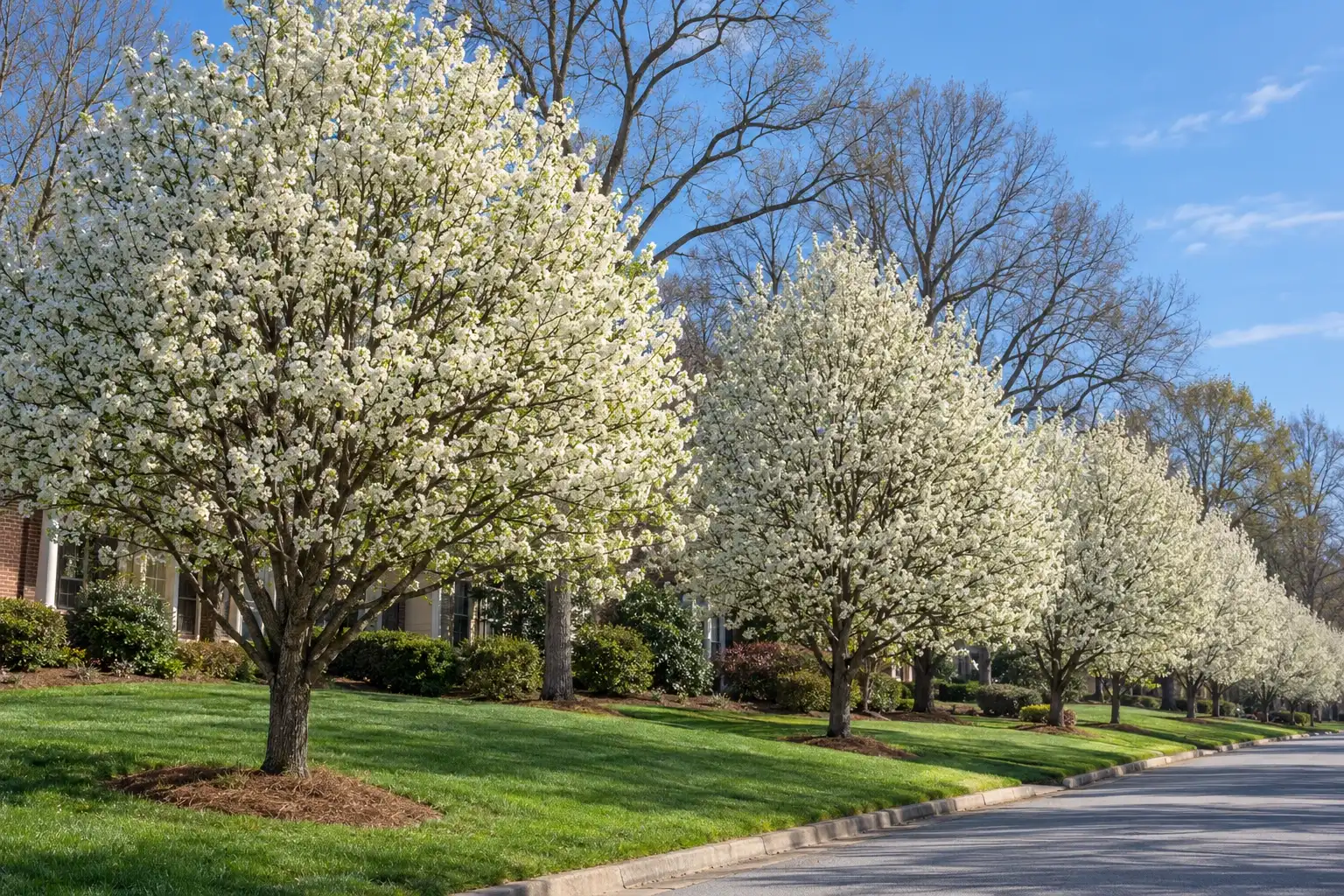
Every March, Columbia’s roadsides and subdivisions turn white with Bradford pear blossoms. They are pretty for about two weeks. They also smell bad, split apart in storms and have spread into fields and woodlands across the state as invasive Callery pear thickets. South Carolina has now taken action, and homeowners have a good reason, and some help, to remove them.
The sale ban: what it means
Starting October 1, 2024, it became illegal to sell Bradford pears and other Callery pear cultivars in South Carolina (Clemson News). Nurseries and garden centers can no longer offer them.
What the ban does not do:
- it does not make it illegal to own a Bradford pear;
- it does not require you to remove existing trees.
The point is to stop new plantings while encouraging voluntary removal.
Why Bradford pears are a problem
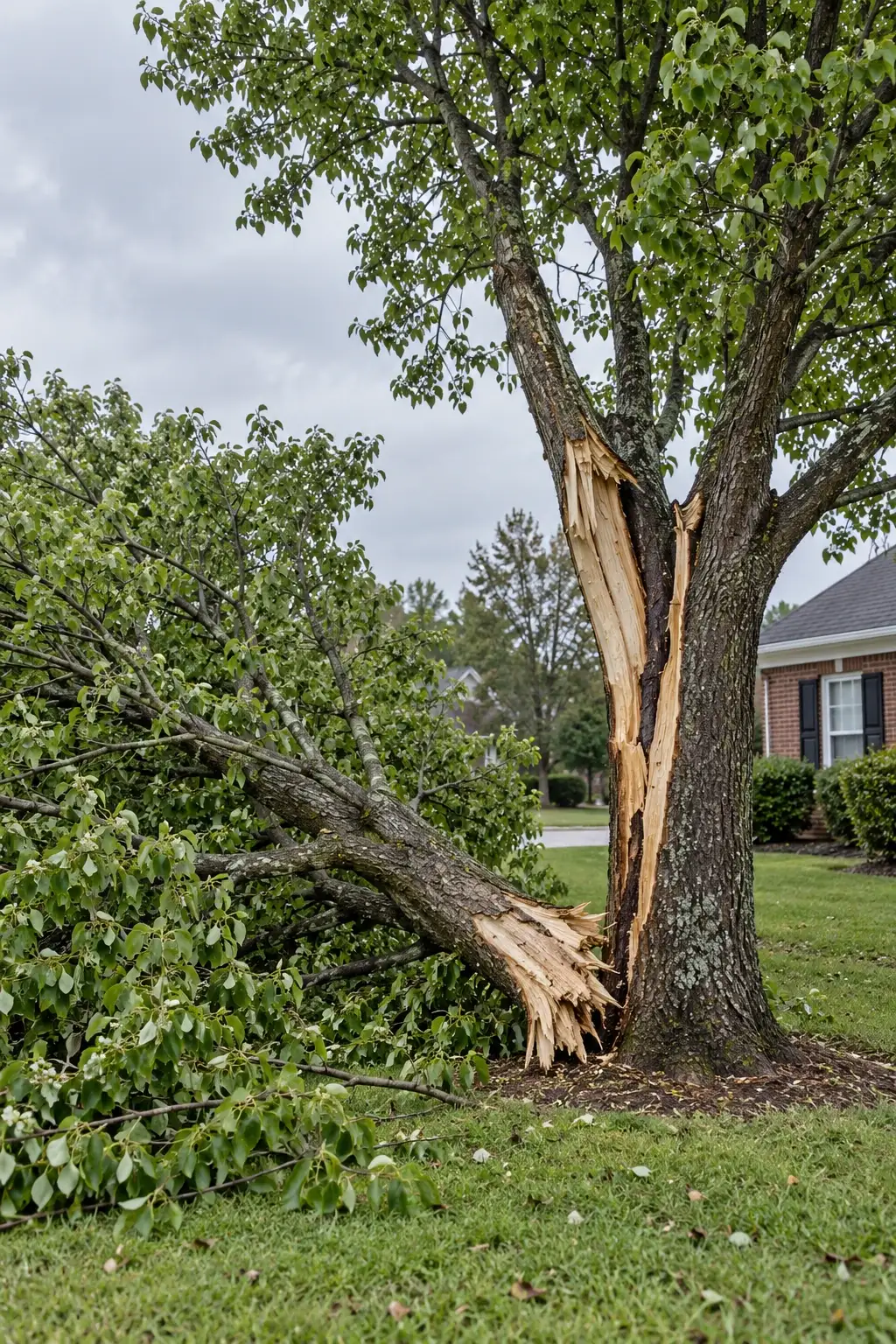
They split
The Bradford pear grows many upright branches from nearly the same point on the trunk. Those narrow, V-shaped unions trap bark inside them (called included bark), so the branches are barely attached by wood. Around 15 to 20 years old, as the branches get heavy, Bradford pears commonly split apart in wind or ice, often in half, onto cars, fences and roofs. Cabling is rarely worth it on a tree this short-lived and split-prone.
They spread
The original Bradford pear was meant to be sterile, but cross-pollination with other Callery pear cultivars produces fruit. Birds spread the seeds, and wild Callery pears now form dense, thorny thickets that crowd out native plants in fields and forest edges across South Carolina.
And yes, the smell
The blossoms have a strong, unpleasant odor that most people notice every spring.
The Bradford Pear Bounty
Clemson Extension, working with the SC Forestry Commission and partners, runs a Bradford Pear Bounty: homeowners who remove Bradford pears can trade them for free native trees. In past programs, participants could swap up to five trees, with pre-registration and proof of removal required, and exchange events held in spring and fall (Clemson Extension).
Details, dates and locations change from year to year, so check Clemson’s bounty page for the current program before you cut, and register first if registration is required.
How to remove a Bradford pear
Small trees
A young Bradford pear in an open yard is a simple removal. Cut it low, then deal with the stump.
Large trees
Mature Bradford pears near houses, fences or driveways can weigh more than they look, and split trees are under tension. They are taken down in sections like any other tree near a structure. See tree removal in Columbia.
Stop the resprouts
Callery pear stumps and roots often resprout. To keep it from coming back:
- grind the stump below grade, a little deeper than usual;
- grind the main surface roots near the stump;
- cut any sprouts that appear over the next season or two.
See stump grinding and the stump grinding cost guide.
What to plant instead
For spring flowers without the problems, consider native trees such as:
- eastern redbud, with pink-purple flowers before the leaves;
- flowering dogwood, South Carolina’s classic spring tree;
- serviceberry, with white flowers and berries birds love;
- fringetree, with lacy white flowers.
Plant the right tree for the space, with room for its mature size, and away from power lines and the house.
The bottom line
You do not have to remove your Bradford pear. But if it is near the house, the driveway or the street, it will probably split eventually, and the bounty makes now a good time to replace it with something better.
Bradford pears around Columbia
Bradford pears were planted by the thousands across the Midlands from the 1980s on: along Two Notch Road and Forest Drive, in front yards across Lexington and Irmo, and at the entrances of subdivisions in Northeast Columbia and Blythewood. Many of those trees are now 25 to 40 years old, well past the age when they start to split. Drive around Columbia in March and the white blooms show how many remain, including wild Callery pears spreading along roadsides and field edges in Richland and Lexington counties.
If you have one near the house, the driveway or a fence, the question is not really whether it will split, but when. Removal before the next big storm, and replacement through the bounty, is usually the sensible move.
Removal costs for Bradford pears
Most Bradford pears are small to medium trees, so they sit toward the lower end of Columbia-area removal prices, which run about $400 to $1,800 for a typical single tree (HomeBlue, 2026). A large pear over a roof or a split tree under tension costs more. Stump grinding, which stops resprouting, averages about $309 per stump in Columbia (HomeAdvisor), and several stumps on the same visit cost much less each. See the tree removal cost guide.