Co-dominant stems and included bark
Most strong trees have one main trunk with smaller branches attached to it. The branch grows a ridge of wood, the branch bark ridge, where it meets the trunk, and that joint is strong.
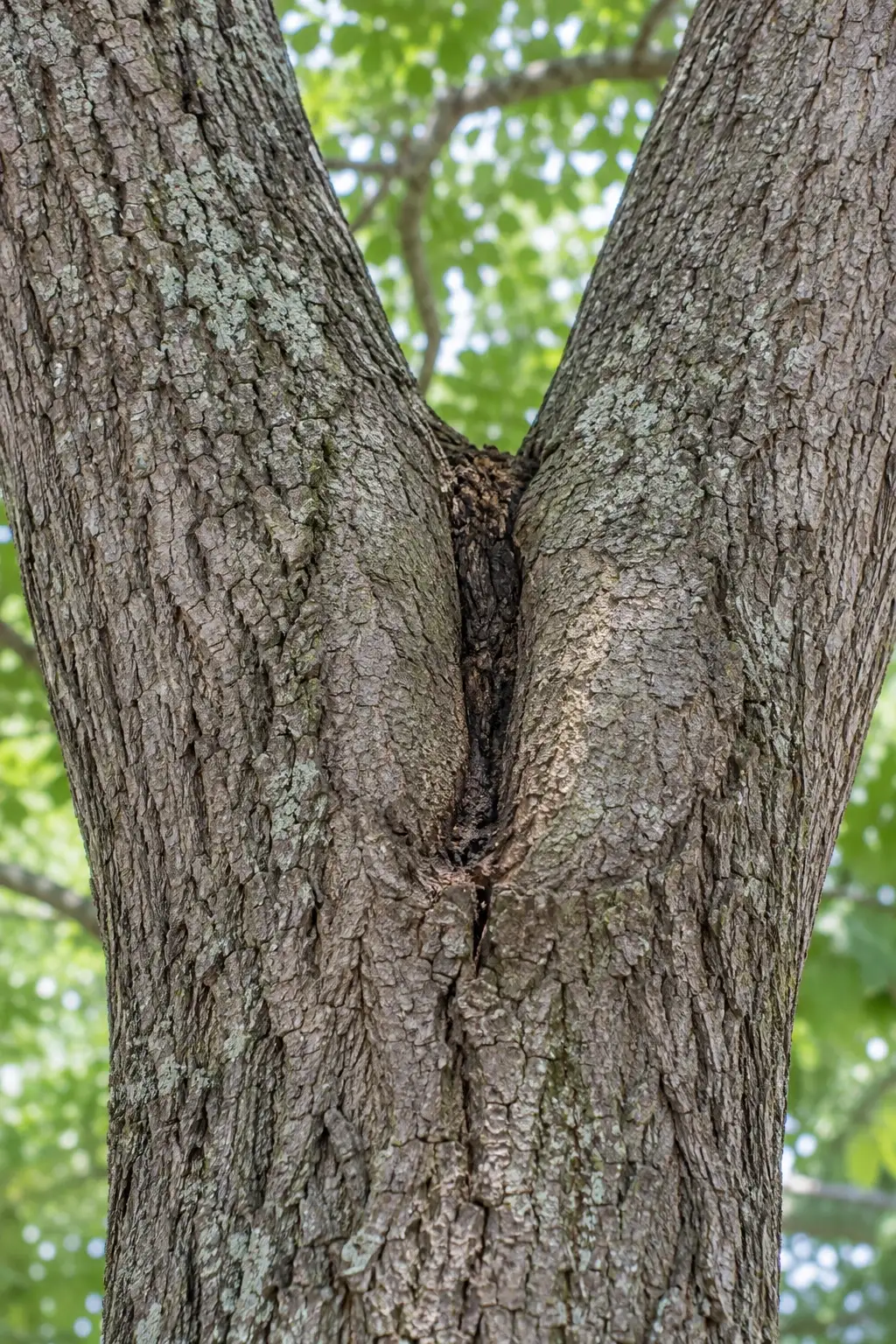
Problems start when a tree grows two or more trunks of equal size from the same point. These co-dominant stems compete instead of one leading. As they thicken, they push against each other. If bark gets trapped in the narrow V between them, called included bark, the stems are not really joined by wood at all. They are held together by a thin layer of bark, and in a strong wind or under ice, they can split apart.
Included bark is common in Bradford pears (which is why they so often split in half), red maples, water oaks and some willow oaks. You can often spot it: a tight V-shaped union with a seam of bark running down into it, sometimes with a crack or weeping beneath.
Dynamic vs static systems
| Static (steel) | Dynamic (synthetic) | |
|---|---|---|
| Material | Steel cable with eye bolts or lags | Synthetic rope systems with shock absorbers |
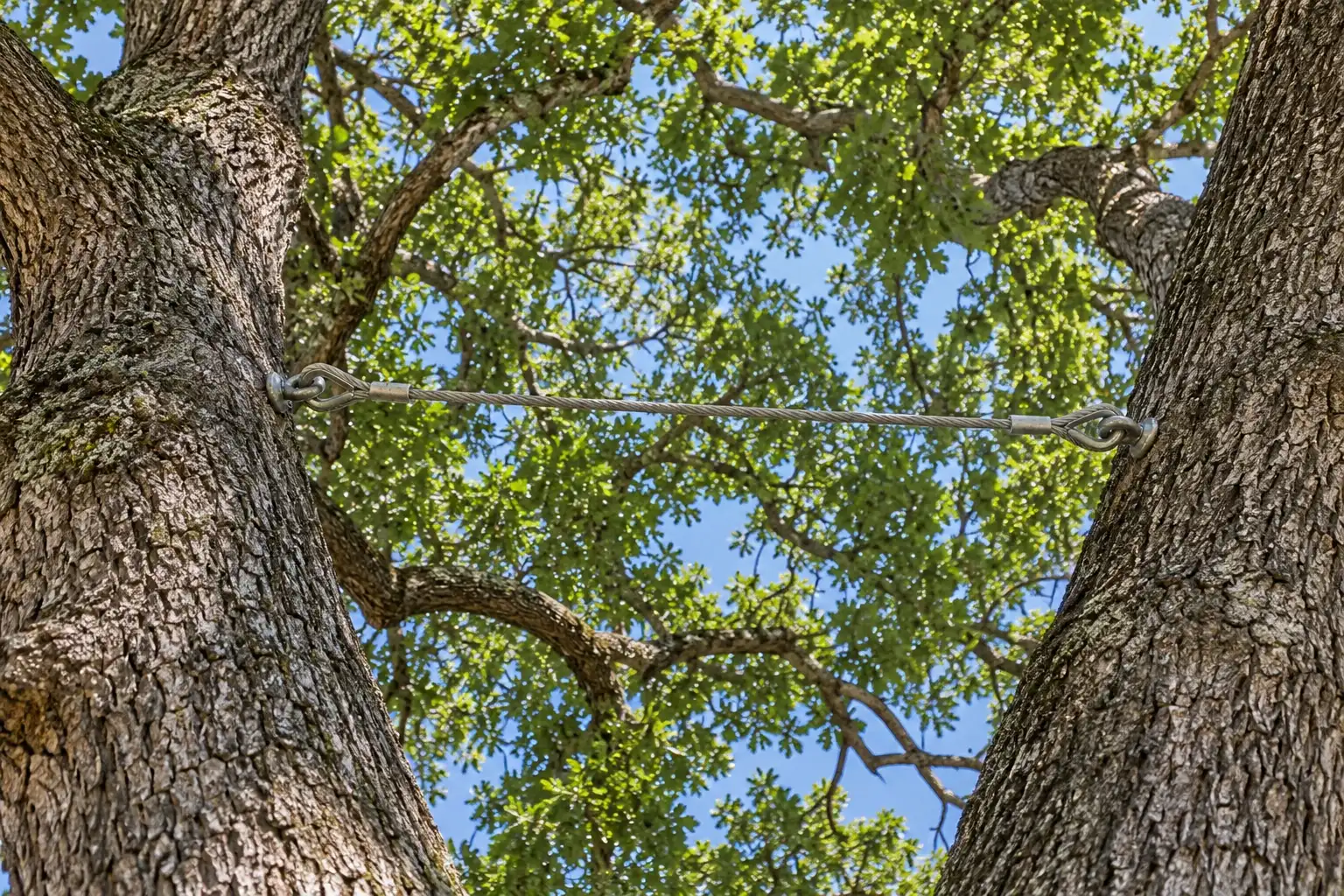
| Movement | Holds stems rigidly | Lets stems move, limits extreme movement |
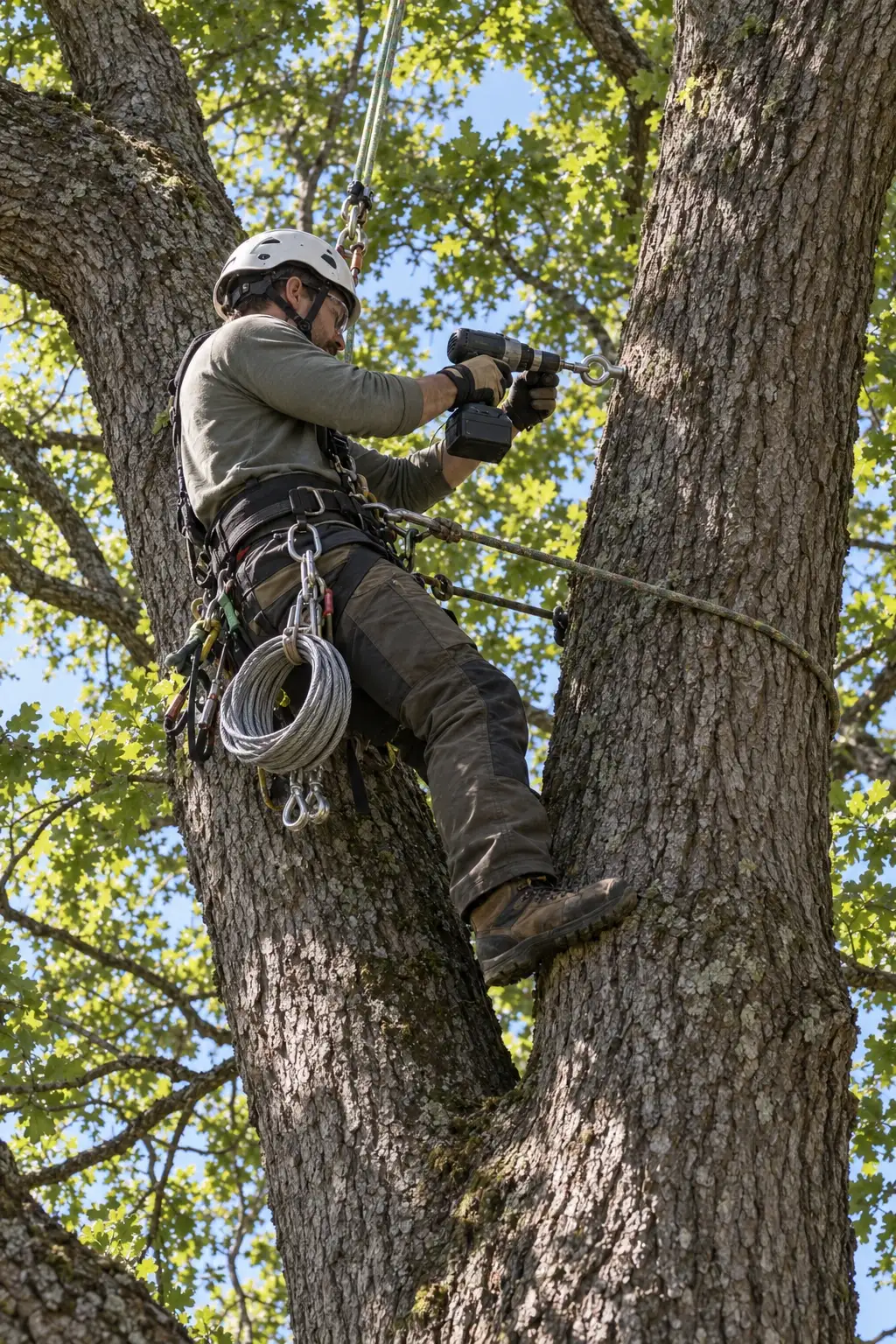
| Installation | Holes drilled for hardware | Usually no drilling |
| Best for | Serious defects, existing splits | Moderate defects, preventive support |
| Service life | Long, with inspection | Shorter; replace on schedule |
Both are covered by the ANSI A300 standard for supplemental support systems. The right choice depends on how serious the defect is and how much risk is acceptable for what is underneath.
Inspection intervals
A support system is not install-and-forget. Trees grow, hardware can loosen or wear, and storms can overload a system. Plan for an inspection every one to two years and after any major storm, and keep a record of when the system was installed and checked.
When cabling is not enough
Cabling helps a sound tree with a specific weakness. It is not a fix for a failing tree. Skip cabling and consider removal when:
- decay has hollowed out the trunk or the union;
- the crown is dead or declining;
- the split has already opened wide;
- the root plate is lifting or roots are decayed;
- the tree is a short-lived, split-prone species that is not worth the investment, such as a Bradford pear, whose sale South Carolina banned from October 1, 2024 (Clemson News).
An arborist assessment gives a clear yes or no before any hardware goes in.
Cabling vs removal: the trade-off
For a large oak that shades the house, frames the yard and would cost thousands to remove, cabling can buy many more years of safe life at a fraction of the price. For a tree with serious decay over a bedroom, no system is a substitute for removal. A good estimate explains both options honestly.
Cabling in Columbia: oaks, maples and storm season
Around Columbia, cabling requests usually involve three kinds of trees.
Big co-dominant oaks. Willow oaks and water oaks in older neighborhoods such as Forest Acres, Shandon and West Columbia often split into two or three large trunks low down. When those trunks spread over a house, a support system high in the crown, combined with light reduction pruning, can reduce the chance of one stem tearing away in a storm.
Red maples and young oaks in newer subdivisions. In Lexington, Irmo and Northeast Columbia, young trees with tight V-shaped unions are better corrected early with structural pruning than cabled later. Cabling a young tree is usually a sign that pruning was missed.
Trees damaged in a storm. After a storm like Hurricane Helene, a tree with a partial split sometimes asks the question: cable or remove? If the split is small and the tree is otherwise sound, a brace rod and cable may stabilize it. If the split is wide or decay is present, removal is safer.
Timing matters too. Installing supports in late winter or spring, before hurricane season starts on June 1, gives the most protection when it is needed. A system installed today should be inspected every one to two years and after any major storm.