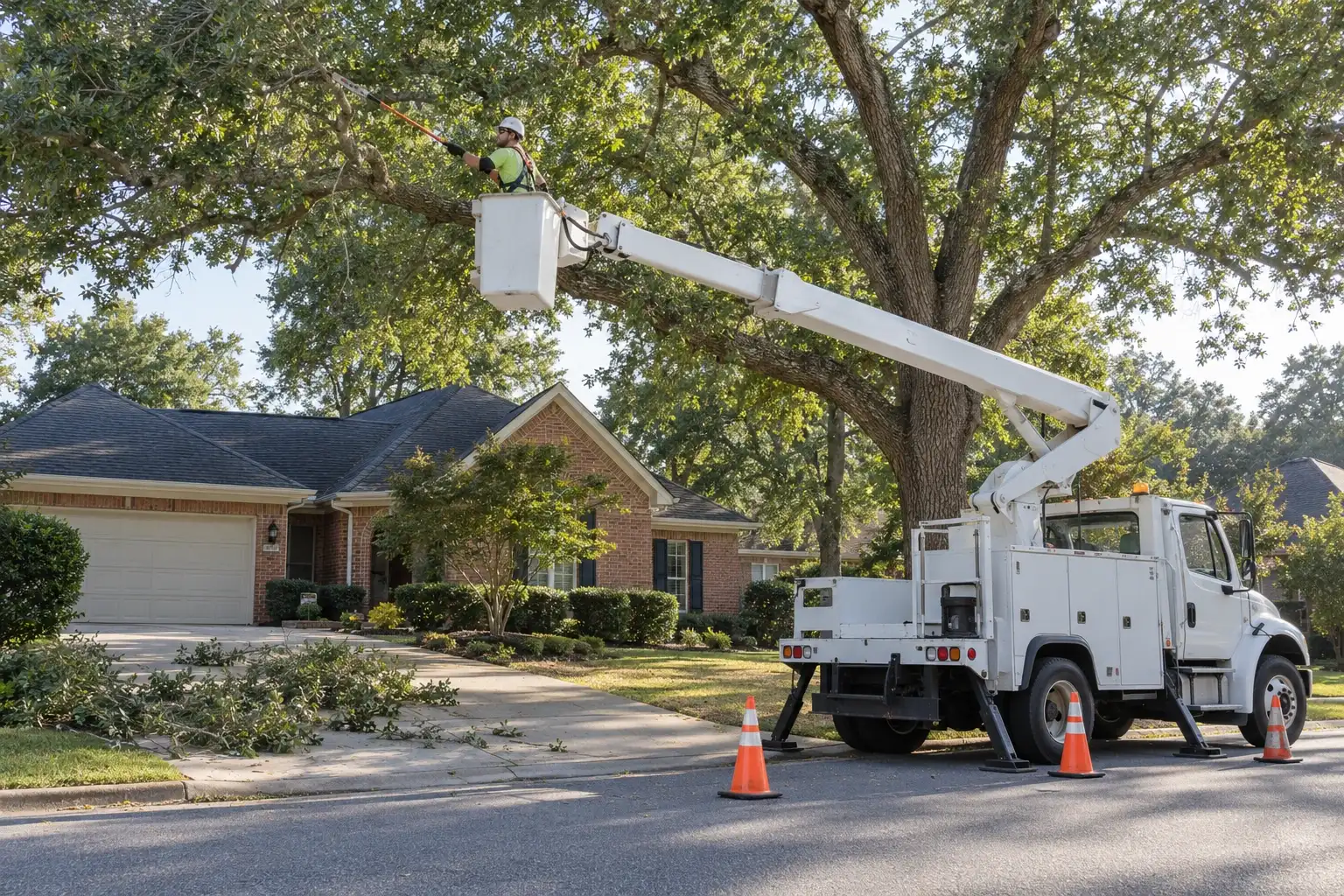
The short version
Nationally, most trees cost $430 to $640 to trim in 2026. By height, trees under 30 feet run about $85 to $415, trees 30 to 60 feet about $215 to $790, and trees over 60 feet about $475 to $1,835 (LawnStarter, September 2026).
For Columbia specifically, the most local hourly data we found is older: in February 2021, HomeBlue put a three-person crew at about $181 to $241 per hour (average about $211), and a typical three-to-four-hour job at $540 to $950 (HomeBlue). Labor and fuel costs have risen since, so treat those numbers as a floor.
What changes the price
Height and spread
Taller trees need more climbing or a bucket truck. Wide-spreading oaks have more limbs to reach. That is why the over-60-foot band is so broad: a tall, narrow pine and a huge spreading willow oak are very different jobs.
What the tree is over
Pruning over open lawn is straightforward. Limbs over roofs, carports, pools, fences and power drops are cut in small pieces and lowered on rope, which takes longer.
Type of pruning
- Deadwooding (removing dead and broken limbs) is the most common and often the most valuable.
- Crown thinning takes skill and time, since cuts are spread through the whole crown.
- Crown raising over a driveway or roof is usually quicker.
- Crown reduction of long limbs over a house is detailed, rigging-heavy work.
Condition
Trees with a lot of dead wood, storm damage or decay take more time and care.
Access
A bucket truck needs a firm path to the tree. Backyards behind narrow gates mean climbing and carrying brush out by hand. Wet red clay in Irmo, Chapin and Seven Oaks can delay work or require mats.
Number of trees
Several trees on one visit cost less per tree than separate trips, since setup and travel are paid once.
Cleanup
Chipping brush and hauling it away is part of most quotes, but check. Leaving chips for mulch can save money.
Columbia pruning notes
- Big oaks over older homes. Shandon, Forest Acres, West Columbia and Dentsville have mature water and willow oaks over roofs. Roof clearance and deadwooding are the core jobs, and they sit toward the top of the price bands.
- Storm season timing. Hurricane season runs June 1 to November 30. Pruning in late winter or spring is cheaper and easier to book than emergency work after a storm.
- Crape myrtles. Usually in the lowest band. Proper pruning removes suckers, crossing branches and dead wood in late winter, never topping (Clemson HGIC).
- Pines. Lifting low limbs and removing dead branches is reasonable; heavy crown pruning on pines does not make them safer.
How to get an accurate trimming quote
Send photos of the whole tree, the parts that worry you (limbs on the roof, dead branches, the driveway clearance), and the access from the street. Tell the estimator your goal: storm safety, roof clearance, more light on the lawn or a view. A clear goal keeps the quote focused and avoids paying for cuts you do not need.
Ways to save
- Prune in late winter, the best time for most trees and often a slower season.
- Bundle trees into one visit.
- Prioritize: deadwood and roof clearance first, cosmetic thinning later.
- Start young. Structural pruning of young trees every few years is cheap and prevents expensive problems later.
- Keep the chips if you can use them as mulch.
Red flags
Be wary of anyone who:
- offers to top your trees or “cut them back by half”;
- climbs trees you are keeping with spikes;
- suggests flush cuts against the trunk;
- will not describe the work in writing;
- cannot show a certificate of insurance.
Topping makes trees weaker and more dangerous over time (ISA). Good pruning follows the ANSI A300 standard, and a good estimate says so.
Trimming costs by tree type around Columbia
Height bands tell you a lot, but the tree itself matters too. Here is how the common Midlands trees tend to price, using the national bands above.
- Water and willow oaks. The big shade trees of Shandon, Forest Acres, West Columbia and Dentsville. Mature ones are usually over 60 feet with long limbs over roofs, so they sit in the $475 to $1,835 band, toward the higher end when there is heavy deadwood or careful rigging over a house.
- Southern red oak and white oak. Similar in size and price, but often sounder wood and less frequent deadwood.
- Loblolly pines. Little routine pruning is needed. Lifting low limbs or removing dead branches from a tall pine is usually quick once a climber or bucket truck is set up.
- Crape myrtles. Usually under 30 feet, so in the $85 to $415 band. Several on one visit cost less each.
- Southern magnolias. Dense, evergreen and often low-branched. Lifting the crown for clearance is common; heavy pruning is rarely needed.
- Leyland cypress screens. Priced more like hedge work by the run than per tree, and often a question of removing dying sections.
- Pecans. Brittle wood that drops limbs in storms; deadwooding older pecans near houses is worthwhile.
- Young trees in new subdivisions. Structural pruning of a young oak or maple is quick and cheap, and it is the best value in tree care: it prevents the weak unions that cost a lot later.
Hourly vs per-tree pricing
You will see both.
Per-tree or per-job pricing is the most common for homeowners. The estimator looks at the tree, decides what the job needs and gives you one number. It is simple to compare, as long as the scope is written down.
Hourly pricing is common for bigger or less predictable jobs, and for commercial maintenance. Older Columbia data from HomeBlue put a three-person crew at about $181 to $241 per hour in 2021, and rates have risen since. With hourly pricing, ask for an estimate of the hours and a cap.
Either way, the price is mostly crew time plus equipment: a bucket truck, a chipper and the trucks to haul brush.
Trimming vs removal: when is a tree worth paying to keep?
A big healthy oak adds shade, cools the house in a South Carolina summer and is hard to replace in your lifetime. Paying a few hundred dollars every few years to keep it safe is usually worth it. Trimming stops making sense when:
- the tree has serious decay in the trunk or major unions;
- it is dead or dying, or a pine with beetle damage;
- it is the wrong tree in the wrong place, such as a pine a few feet from the foundation or a Bradford pear over the driveway;
- each round of pruning is fighting constant limb drops from an aging water oak.
In those cases, see the tree removal cost guide. An arborist assessment settles it when you are unsure.
How often to budget for trimming
| Tree | Typical interval |
|---|---|
| Young shade trees (structural pruning) | Every 2–3 years |
| Mature oaks over houses | Every 3–5 years, plus storm checks |
| Crape myrtles | Light pruning most winters |
| Pines | As needed: dead limbs, clearance |
| Commercial and HOA trees | Annual inspection, pruning on a cycle |
Budgeting a modest amount every few years is far cheaper than paying for an emergency crane after a limb comes through the roof.
What a good trimming estimate includes
A clear written estimate for pruning should tell you:
- Which trees and what objective for each: deadwood, roof clearance, thinning, raising, reduction.
- How much will be removed, in plain words, and that cuts follow ANSI A300.
- No topping, and no climbing spikes on trees being kept.
- How limbs over the house will be lowered.
- Cleanup: brush chipped and hauled, gutters checked, lawn raked.
- The price per tree or per job, and payment due after the work.
When two estimates use the same objectives, their prices are usually close. When they are far apart, one of them is usually doing less, or topping.
Why trimming costs more after a storm
Prices for the same pruning job are often higher after a big storm, for three reasons. Demand jumps, because every homeowner with a broken limb calls at once. The work itself is harder and riskier: broken limbs hang under tension, hangers have to be removed before anything else, and damaged trees cannot always be climbed. And crews prioritize trees on houses and blocked driveways, so routine pruning waits.
The cheapest time to prune the big trees near your house is late winter and spring, well before hurricane season starts on June 1. Deadwooding and roof clearance done then often prevent the emergency call entirely.
One last tip: ask for the pruning objective in writing for each tree. It is the easiest way to make sure two quotes cover the same work.