Who commercial tree service is for
Trees on commercial and community property raise questions homeowners never face: who approves the work, who is liable if a limb hits a car, how to schedule around residents, and how to budget across a year. Around Columbia, commercial tree work typically serves:
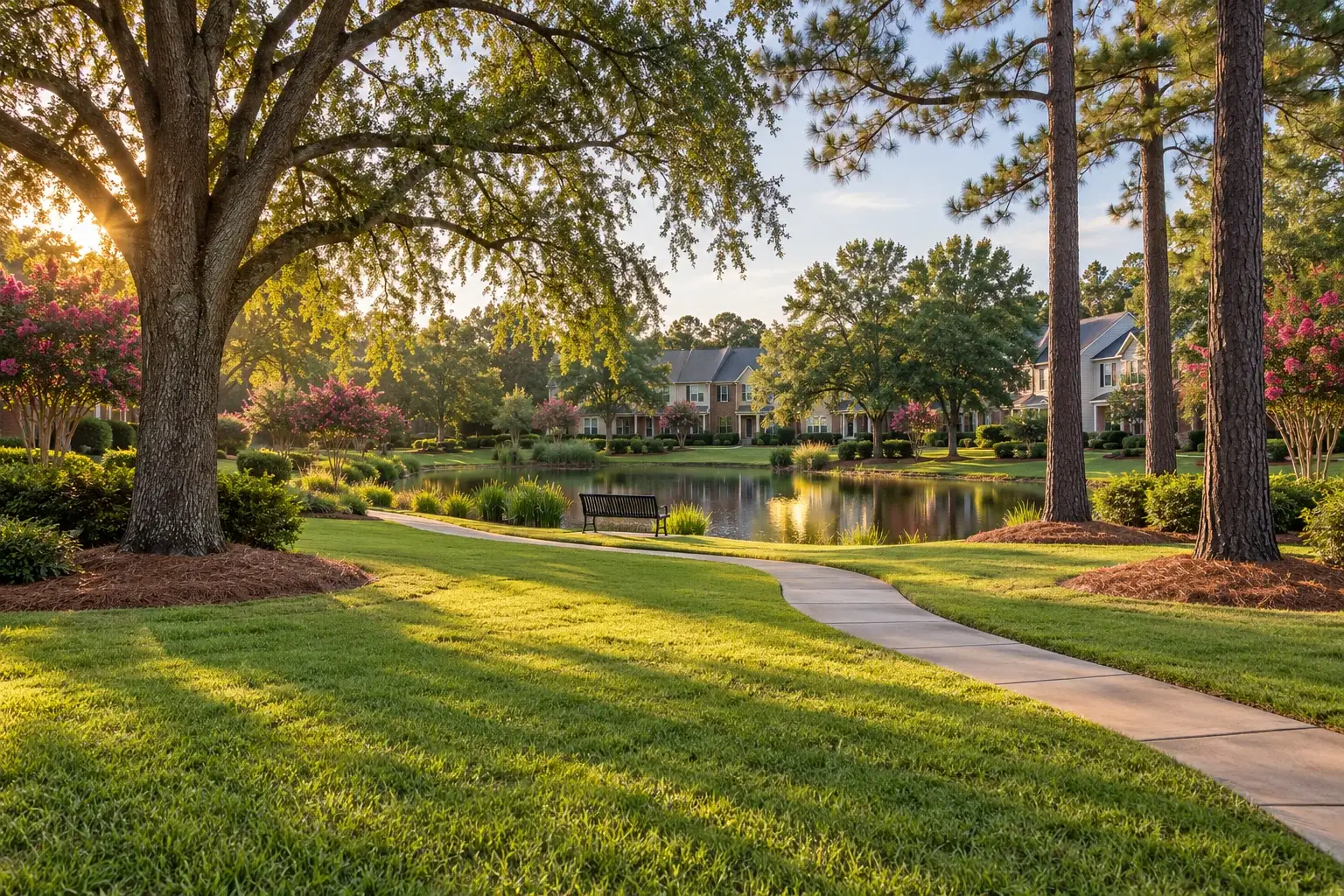
- HOAs in Lexington, Irmo, Northeast Columbia and Blythewood, with common areas, entrances, ponds and walking trails;
- apartment communities with parking lots, playgrounds and buildings under big oaks;
- churches and schools, where large old trees shade parking and playgrounds;
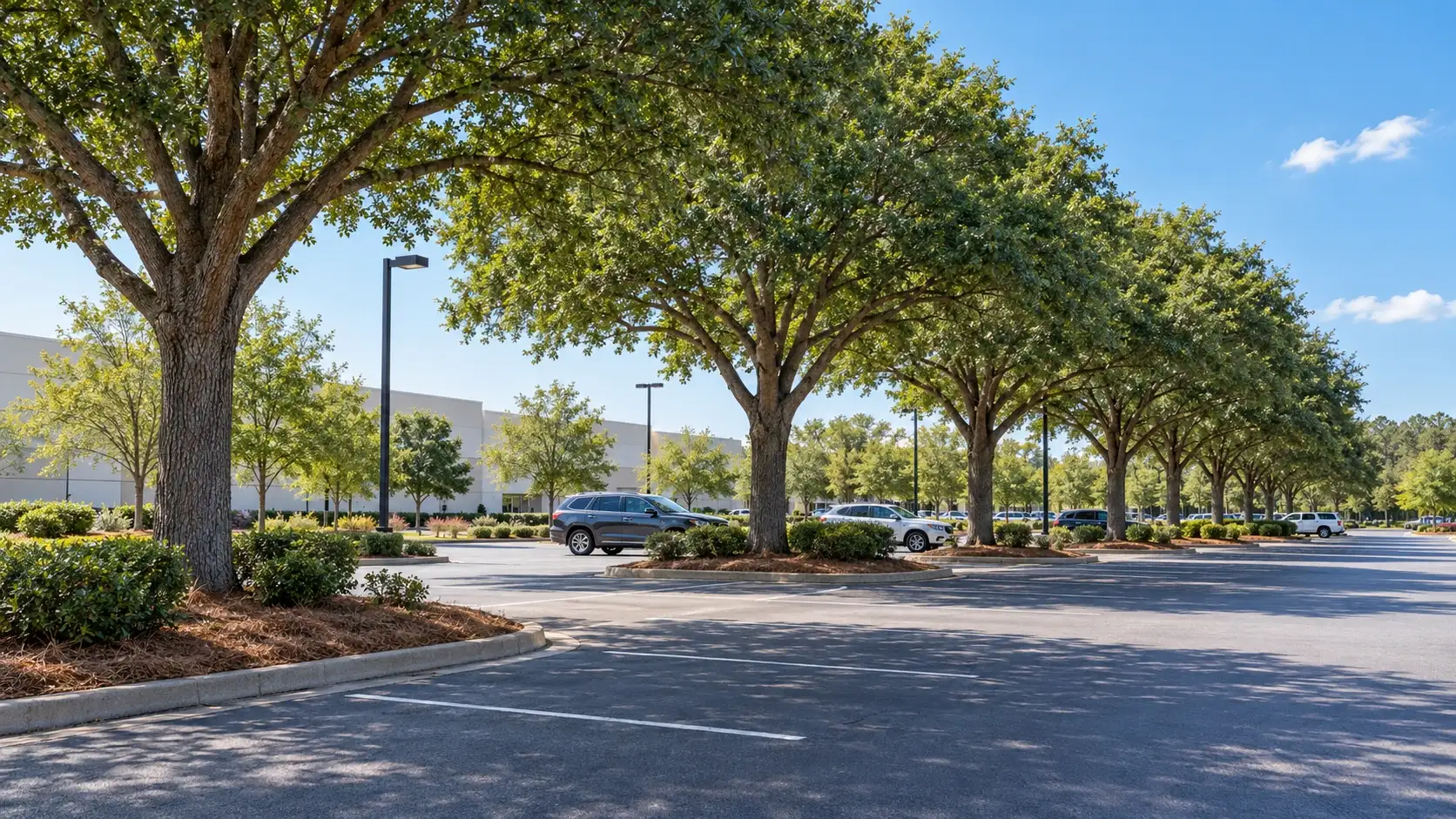
- office, retail and medical properties along Harbison Blvd, St Andrews Rd, Sunset Blvd and Two Notch Rd;
- property managers handling several sites.
Maintenance plans
A one-off visit fixes today’s problems. A plan prevents tomorrow’s. A typical annual plan includes:
- An inspection of all trees in common areas, noting hazards, clearance problems and trees in decline.
- Hazard work first: dead, cracked and leaning trees near people and buildings.
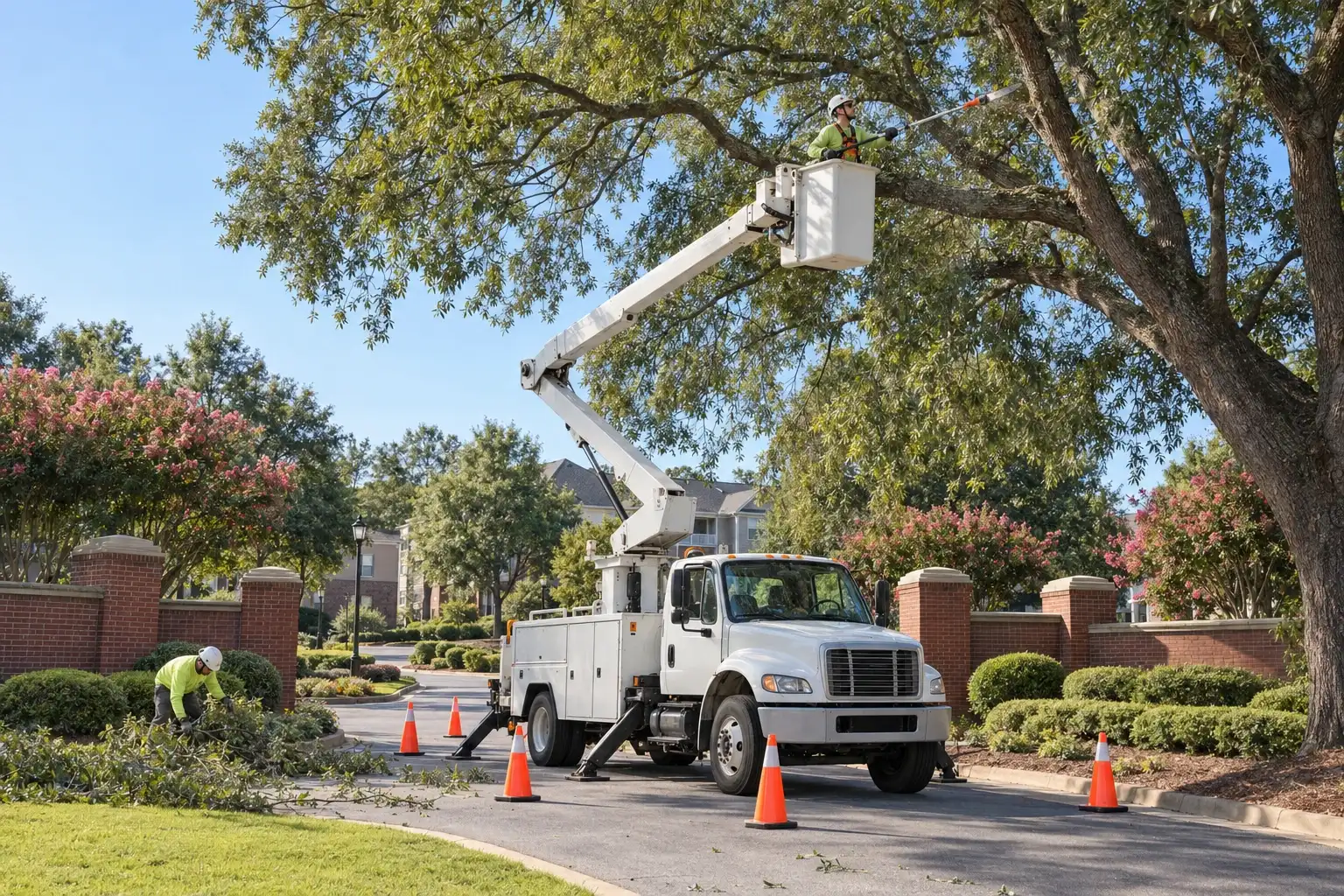
- Clearance pruning on a cycle: sidewalks, parking, lights, signs and roofs.
- Structural pruning of young trees, so today’s saplings become strong trees instead of tomorrow’s hazards.
- Storm response priority for properties on a plan.
Plans spread costs across the budget year and give boards documentation that they are managing their trees responsibly.
Sidewalk and parking-lot clearance
Common targets for clearance pruning are enough height over sidewalks for people to walk without ducking, enough over parking spaces and drive lanes for trucks and vans, and clear sight lines at entrances and around signs and lights. Raising the crown this way follows ANSI A300 pruning practice: removing low limbs back to the trunk or a lateral branch without stripping the tree or topping it.
Willow and water oak roots lifting sidewalks and curbs are a frequent liability concern. Root pruning near hardscape can damage or destabilize a tree, so it should be planned with care, and sometimes replacement is the honest answer.
Permits for commercial property
Commercial land is treated differently from single-family lots. In the City of Columbia, the tree removal permit applies to private property other than single-family residential lots, and development can trigger a tree survey and protection plan (City of Columbia Planning & Development). Forest Acres, Lexington and the counties have their own ordinances. Check with the right office before removing trees on commercial or HOA land.
Insurance, safety and paperwork
Commercial clients should expect, and insist on:
- certificates of insurance for general liability and workers’ compensation, naming the owner and manager, sent from the insurer;
- written scopes by area or tree, with photos, that a board can approve;
- safety set-up: cones, signs, drop zones and traffic control, following ANSI Z133 practice and OSHA requirements (OSHA);
- clear invoicing that matches the approved scope and your payment process.
Storm response for properties
After a major storm, properties with residents and tenants need help fast: entrances blocked, trees on buildings, limbs across parking lots. Having a tree contact and a plan in place before hurricane season, which runs June 1 to November 30, means faster help when every crew in the Midlands is booked.
What commercial tree work costs
Commercial jobs are priced by scope rather than by a single tree. A walk-through produces a written scope, area by area or tree by tree, with a price your board or owner can approve. What moves the price:
- Number and size of trees, and how many need hazard work versus routine clearance.
- Access and traffic control: parking lots, entrances and busy roads need cones, signs and sometimes after-hours work.
- Equipment: bucket trucks for clearance over lots and buildings, cranes for big trees near structures.
- Scheduling: work split into sections so residents and tenants keep access costs a little more than one long closure.
- Plan vs one-off: annual plans spread costs and usually price routine work more efficiently than repeated emergency calls.
For a sense of single-tree prices, most residential removals in the Columbia area run $400 to $1,800, and trimming a large tree over 60 feet runs about $475 to $1,835 nationally (LawnStarter, 2026). Commercial scopes combine many of these, so a written walk-through price is the only reliable number.